
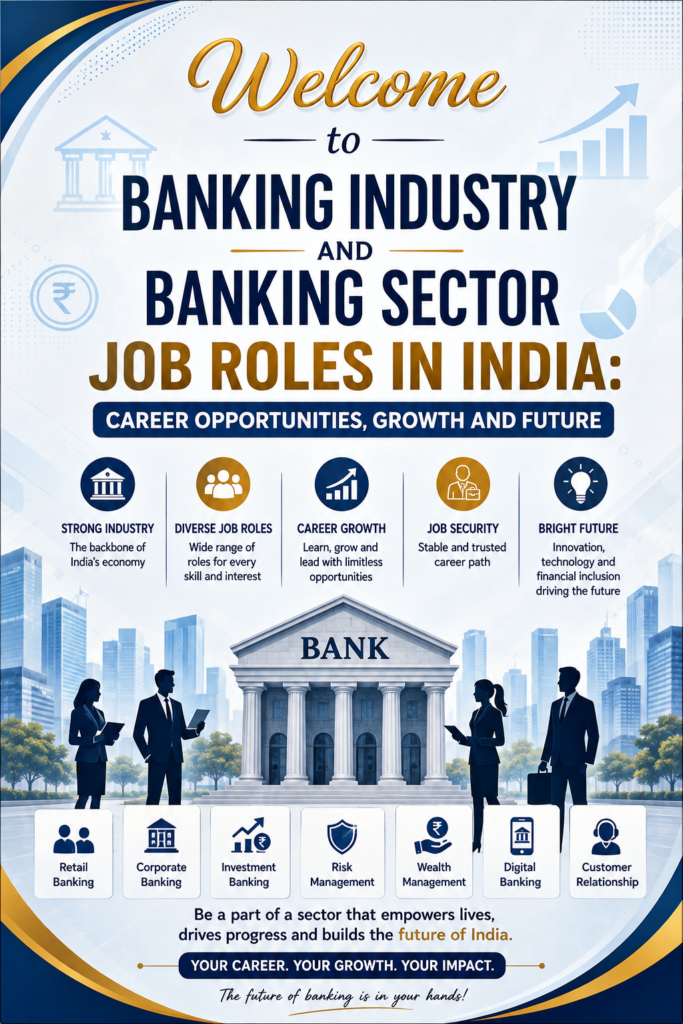
Banking Industry and Banking Sector Job Roles in India: Career Opportunities, Growth and Future
The banking sector has always been one of the most attractive career choices in India. For many graduates, a banking job represents more than just a monthly salary—it can provide stability, professional growth, learning opportunities and a chance to build a long-term career. Even today, banking continues to offer opportunities across public-sector banks, private banks, regional rural banks, cooperative banks, financial institutions and specialised banking services.
The nature of banking jobs, however, has changed considerably over the years. Banks are no longer dependent only on traditional branch operations. Digital banking, mobile applications, online payments, data analysis, cybersecurity, financial technology and customer relationship management have created new types of roles. As a result, someone interested in banking today has a much wider range of career options than before.
Current Banking Job Opportunities in India
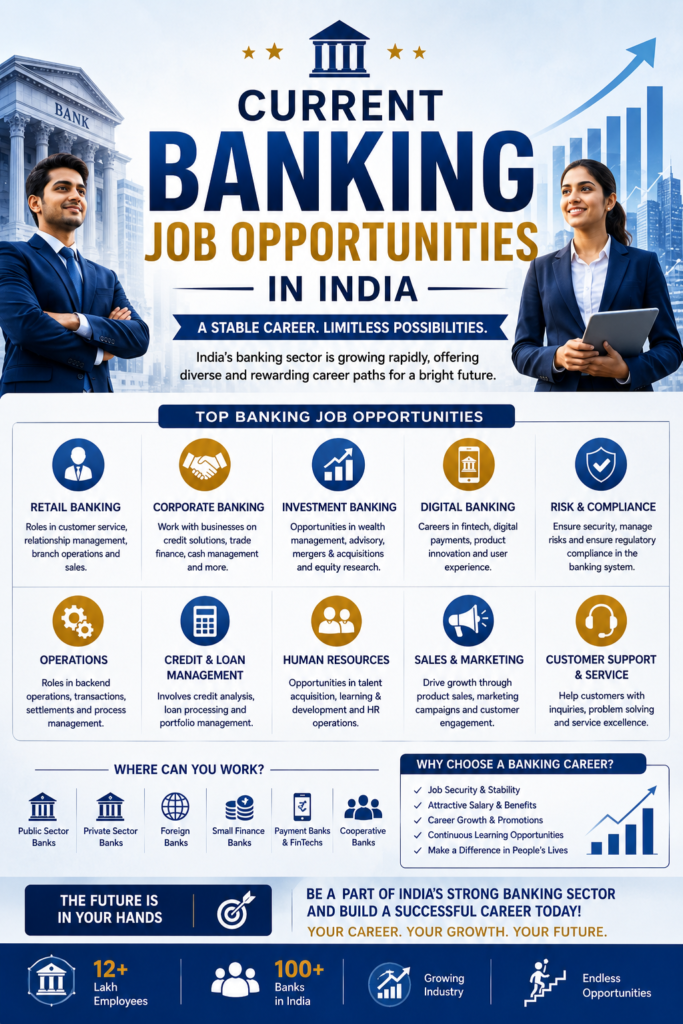
The Indian banking sector currently offers opportunities for both fresh graduates and experienced professionals. Public-sector recruitment continues through examinations and recruitment processes conducted by organisations such as Institute of Banking Personnel Selection (IBPS), while banks such as State Bank of India conduct their own recruitment.
The current recruitment environment shows that opportunities are still significant. For example, SBI has been recruiting Junior Associates in 2026, alongside Specialist Cadre Officers and other positions. IBPS also continues its Common Recruitment Processes for Customer Service Associates, Probationary Officers/Management Trainees, Regional Rural Banks and Specialist Officers.
This tells us something important: banking jobs have not disappeared; instead, the types of jobs and skills required are evolving.
Different Job Roles in the Banking Sector
One of the biggest advantages of choosing banking as a career is the variety of job roles available.
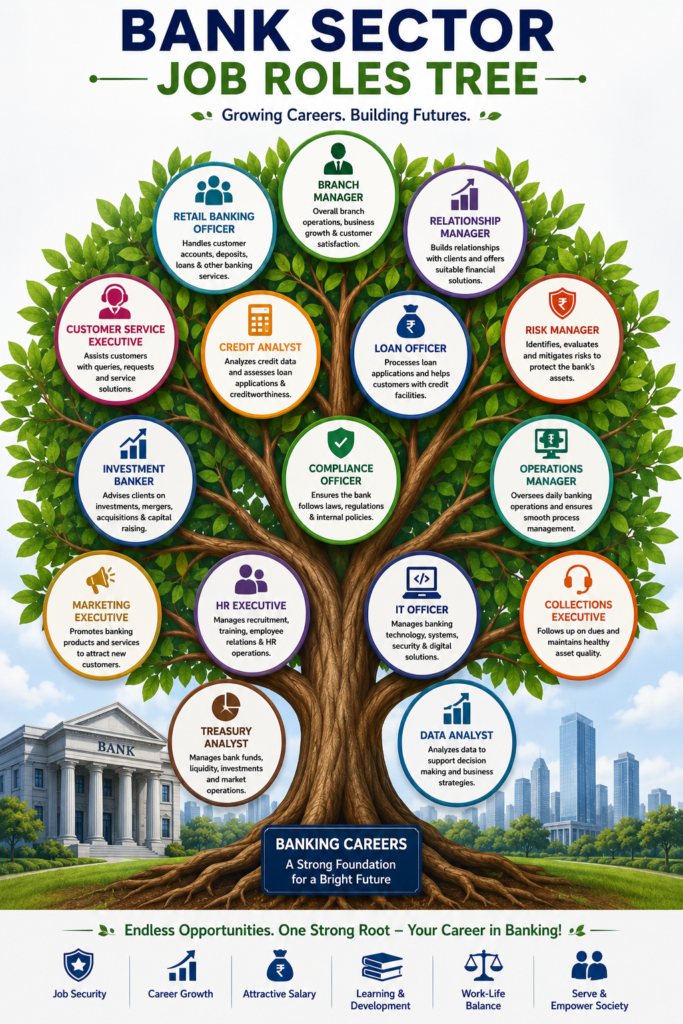
Bank Clerk / Customer Service Associate
Clerical or customer-service positions are generally among the entry-level opportunities for graduates. Employees may handle customer queries, account-related services, documentation, cash transactions and other branch activities.
This can be a good starting point for someone who wants to understand how banking works from the ground level.
Probationary Officer / Bank Officer
A Probationary Officer (PO) role is one of the popular choices among graduates preparing for competitive banking examinations. Officers can be involved in customer service, loans, branch administration, account management and business development.
With experience, officers can move into higher managerial responsibilities.
Specialist Officer
Banking is no longer limited to people with general banking knowledge. Banks also need professionals with specialised skills in areas such as IT, cybersecurity, law, human resources, agriculture, marketing, risk management and finance.
These positions can be particularly attractive to candidates who already have qualifications or professional expertise in a specialised field.
Relationship Manager
Private-sector banks have significant demand for relationship managers. Their responsibility generally involves understanding customers’ financial requirements and helping them with appropriate banking and financial products.
Communication skills, customer handling and sales ability are particularly important in this career path.
Credit and Loan Officer
Credit professionals evaluate loan applications and assess the financial ability of customers or businesses to repay their loans. This role requires an understanding of financial statements, credit risk and banking procedures.
It can become a strong career path for people interested in finance and analytical work.
Digital Banking and Technology Roles
Technology has transformed banking. Today, banks require professionals in areas such as software development, data analytics, cybersecurity, digital payments, cloud technology and information security.
For technology graduates, this creates an opportunity to enter the banking industry without necessarily working in a traditional branch role.
Why Are Banking Jobs Still Attractive?
Banking continues to attract thousands of candidates because it offers a combination of career stability, professional development, financial benefits and opportunities to move into different areas of finance.
For public-sector bank employees, structured recruitment and promotion systems can provide a clearly defined career path. Private banks, meanwhile, can offer opportunities for faster movement based on performance and specialised skills.
Another advantage is that banking experience can open doors to several related areas, including financial services, insurance, investment services, fintech and corporate finance.
However, candidates should remember that a banking job is not automatically an easy or stress-free career. Employees may have performance targets, customer responsibilities, deadlines and pressure during busy periods. Understanding the actual nature of the job is important before choosing this career.
What Qualifications Are Needed for Banking Jobs?
For many graduate-level banking positions, a bachelor’s degree is the basic educational requirement, although eligibility differs according to the specific post and recruitment notification.
Candidates should always check the official notification before applying because age limits, educational qualifications, computer knowledge, local-language requirements and other conditions can vary between recruitment processes.
For example, recent SBI and IBPS recruitment notifications have included graduate-level opportunities with specific age and examination requirements.
Skills That Can Help You Get a Banking Job
A degree alone is not enough to guarantee success. Candidates need to develop practical skills along with examination preparation.
Important skills include:
Quantitative aptitude and basic mathematics
Reasoning and logical thinking
English and communication skills
General and banking awareness
Computer and digital skills
Time management
Problem-solving ability
Customer-service skills
Basic financial knowledge
Confidence and interview skills
For private-sector banking jobs, communication, sales ability and customer relationship skills can be particularly important. For competitive examinations, speed and accuracy become extremely important.
Banking Exam Competition: What Has Changed?
If you have been preparing for banking examinations for several years, you may have noticed that the competition has become more challenging. One reason is the large number of graduates competing for a limited number of positions.
But competition is not the only thing that has changed.
Today’s successful banking aspirant needs to be more adaptable. Earlier, candidates could focus heavily on textbook-based preparation. Today, it is increasingly useful to understand current affairs, digital banking, financial technology, economic developments and basic financial concepts along with the traditional examination syllabus.
The important point is not to become discouraged by the number of candidates. Thousands of people may apply for an examination, but preparation quality varies significantly. A candidate who understands the syllabus, analyses previous mistakes, practises regularly and takes mock tests seriously can still create a strong advantage.
Recent recruitment figures also show that opportunities remain substantial. For example, SBI’s 2026 Junior Associate recruitment and IBPS’s 2026 Customer Service Associate recruitment demonstrate that large-scale banking recruitment continues.
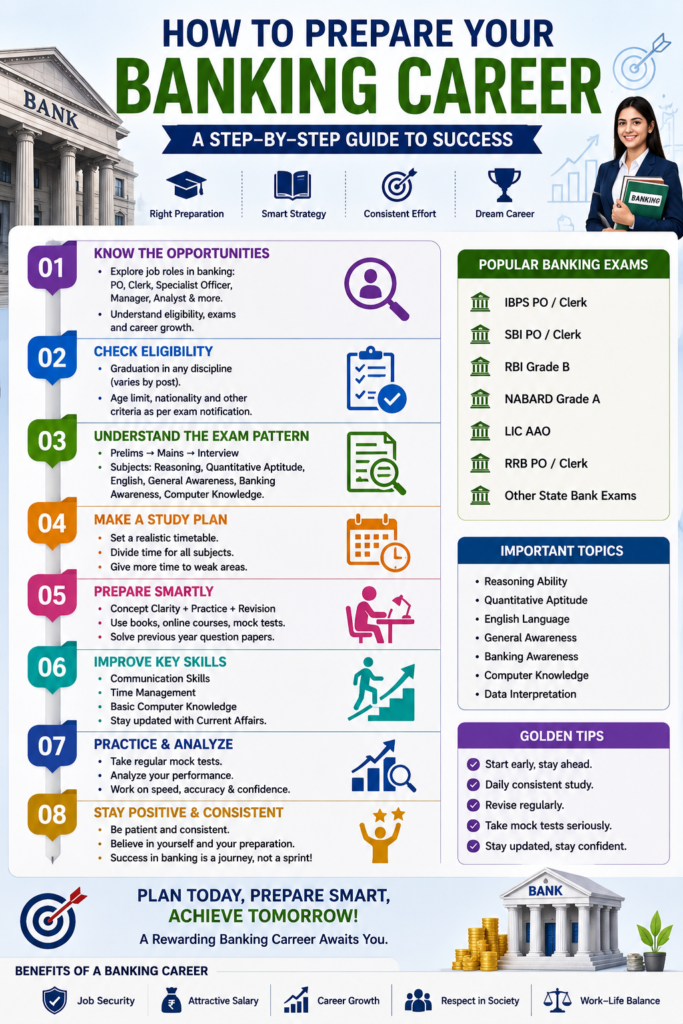
How to Prepare for a Banking Career
A successful banking career begins with choosing the right path. First, decide whether your goal is a public-sector bank examination, a private-sector banking job, a specialist role or a technology-related banking career.
If you are preparing for competitive examinations, don’t simply study for long hours. Study with a plan.
Start by understanding the syllabus and examination pattern. Strengthen your basic concepts, practise questions regularly, take mock tests and analyse your performance. Instead of repeatedly studying topics you already know, identify your weak areas and work on them.
Current affairs and banking awareness should also become part of your regular routine. At the same time, improve your communication and computer skills because these can be useful after you enter the workplace.
Most importantly, don’t measure your progress only by how many years you have been preparing. Measure it by how much your accuracy, speed, knowledge and confidence have improved.
Career Growth in the Banking Sector
Banking can offer a long-term career path if a person continues learning and takes responsibility.
A person may begin in an entry-level position and gradually move into officer, managerial and senior managerial responsibilities, depending on the organisation, performance and promotion structure.
In private banking, employees can also move into areas such as relationship management, branch management, credit, sales leadership, wealth management, operations or specialised financial services.
The growth doesn’t stop after getting the first job. Banking professionals who develop expertise in areas such as risk management, digital banking, analytics, cybersecurity or corporate finance can potentially create specialised career paths.

Advantages of a Banking Career
Some major advantages include:
Multiple career paths: Banking offers both general and specialised roles.
Professional growth: Employees can progress into senior and managerial positions.
Skill development: Banking develops financial, communication, analytical and customer-management skills.
Industry stability: Banking remains an important part of India’s economy.
Opportunities for graduates: Many entry-level positions are open to graduates from different educational backgrounds, subject to eligibility requirements.
Digital career opportunities: The growth of digital banking and fintech is creating technology-oriented roles.
Transferable experience: Banking experience can be useful across several financial-services careers.
The Future of Banking Jobs in India
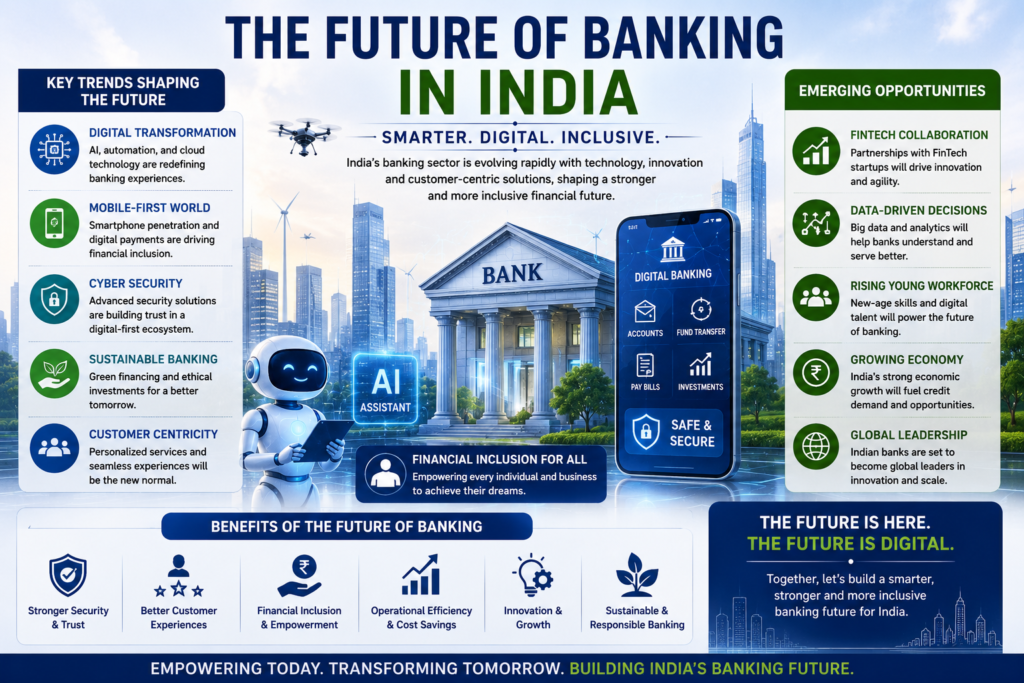
The future of banking is likely to be a combination of people and technology. Digital payments, mobile banking, artificial intelligence, automation and data analytics are changing how customers interact with banks.
This does not mean that traditional banking jobs will simply disappear. Instead, the responsibilities of many employees are changing. Routine processes can increasingly be automated, while human skills such as decision-making, relationship management, financial advice, problem-solving and customer support remain important.
Therefore, future banking professionals should not prepare only to clear an examination. They should prepare themselves to work in a modern, technology-driven financial industry.
Final Thoughts
A career in banking can be a rewarding choice, but it should be approached with realistic expectations. It requires patience, continuous learning and the ability to handle competition and workplace responsibilities.
If you have been preparing for banking examinations for several years and have not yet achieved your goal, that does not automatically mean your efforts have been wasted. Your preparation may already have given you valuable knowledge in reasoning, mathematics, English, current affairs and financial awareness.
The next step is to identify what is holding you back and improve it systematically.
The banking sector is changing, but the opportunity is still there. The candidates who combine strong preparation with communication, digital knowledge, financial awareness and adaptability will be better positioned to build a successful banking career in India.
Quick Key Points for Banking Aspirants
#Complete the required educational qualification.
📚 Understand the exam syllabus and recruitment process.
⏱️ Improve speed and accuracy through regular practice.
📰 Follow banking, economic and current-affairs developments.
💻 Develop computer and digital-banking knowledge.
🗣️ Improve communication and customer-handling skills.
📊 Learn basic finance and banking concepts.
🎯 Choose a career path that matches your strengths.
🔄 Keep upgrading your skills even after getting a job.
💪 Don’t let competition discourage you—focus on preparation quality.